
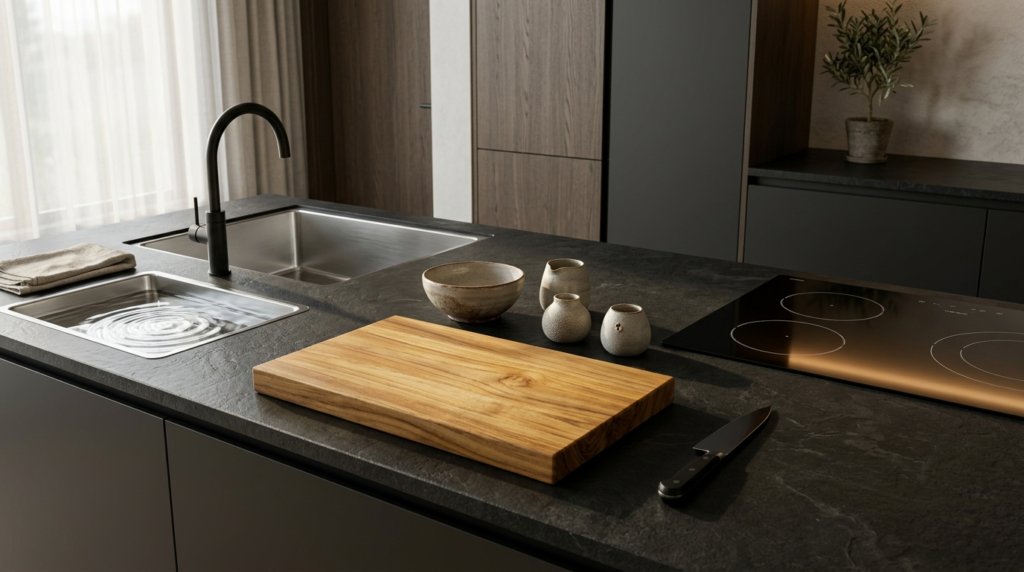
In compact Singapore apartments, a kitchen stove positioned directly opposite or adjacent to a washing sink creates an elemental confrontation known classically as the Fire-Water clash (Huo Shui Xiang Ke 火水相克). Rather than undertaking expensive hacking, homeowners can successfully resolve this spatial tension through classical Wood element mediation, earthen ceramics, and functional interior buffers.
A home kitchen represents far more than an area for food preparation; in classical Chinese metaphysics, the cooking hearth governs family vitality and daily nourishment. When spatial constraints in high-rise apartments force the sink and cooking hob into direct confrontation, understanding the environmental mechanics of Five Elements (Wu Xing 五行) interaction allows residents to cultivate balance without violating structural renovation guidelines.
Why Does a Stove Facing a Sink Cause a Feng Shui Clash?
To understand why a stove directly facing a sink is flagged in classical spatial analysis, one must examine the elemental polarities governing the kitchen.
The cooking stove embodies the Fire element (Huo 火). Fire has two polarities: Yang Fire (丙) is radiant, open warmth, while Yin Fire (丁) is the contained flame of a hearth; the Di Tian Sui (滴天髓) describes 丁 as “丁火柔中,內性昭融” (gentle at the centre, bright within). The stove provides cooked meals, sustaining household energy.
Conversely, the kitchen sink and drainage pipes represent the Water element (Shui 水), embodying fluid cooling.
The Book of Changes (Yi Jing 易經, in its Shuo Gua commentary 說卦傳) describes the eight trigrams in pairs:
“天地定位,山澤通氣,雷風相薄,水火不相射”
(“Heaven and Earth establish their positions, mountain and marsh connect their qi, thunder and wind interact, water and fire do not harm each other.”)
When Water and Fire are in the right relationship, the Book of Changes calls it Hexagram 63, 水火既濟 (Ji Ji, “After Completion”): Water above, Fire below, each doing its work.
However, when a stove and sink face each other across a narrow corridor without an energetic buffer, the picture is closer to Hexagram 64, 火水未濟 (Wei Ji, “Before Completion”): the two elements face each other without resolution. In practical terms, a cramped layout like this also means water splashing towards a hot hob, which is worth fixing for safety alone.
Singapore Apartment Realities: Why Hacking Isn’t Always the Answer
In Singapore’s urban housing—spanning Housing & Development Board (HDB) BTO flats, resale units, and private condominiums—parallel galley kitchens are widespread. In a standard BTO galley kitchen, opposing counters are separated by a walkway that is typically only 800 to 1200 millimetres wide.
Faced with a stove facing a sink, commercial decorators sometimes suggest relocating sink drainage or shifting the gas hob to an opposite wall. In Singapore, however, residential renovations are strictly governed by statutory housing regulations:
- Floor Slab Protection: Official HDB sanitary guidelines explicitly mandate: “Floor slab must not be tampered with” during any repositioning of sinks or washbasins. Hacking into reinforced concrete floor slabs to re-route waste pipes is prohibited to prevent water seepage into lower units.
- Plumbing Authorisation: HDB rules specify that for “Water service and sanitary works”, homeowners “Have to engage a Public Utilities Board (PUB) Licensed Plumber”. Waste pipes cannot simply be embedded arbitrarily across kitchen floors.
- Gas Safety Regulations: HDB guidelines strictly require that for “Gas service works”, residents “Have to engage a Energy Market Authority’s (EMA) licensed gas service worker”, and that “All gas pipe alteration works must be carried out by City Energy Pte Ltd or an Licenced Gas Service Worker (LGSW)”. Town gas pipes must remain exposed or surface-run for ventilation and safety inspection; they cannot be embedded in walls or under floor finishes.
- Living Space Boundaries: HDB rules also mandate: “Gas pipe termination or installation of gas appliances are not allowed in sleeping areas/ bedrooms”, requiring solid physical separation in open-concept studio layouts.
Because structural relocation of plumbing and gas lines is often impossible or cost-prohibitive, classical metaphysics provides a far more practical, non-destructive path: elemental mediation.
The Generative Wood Bridge: How Wood Resolves Fire and Water
In classical Five Elements theory (Wu Xing Sheng Ke 五行生克), elements operate along continuous cycles of generation (Sheng 生) and control (Ke 克).
While Water directly clashes with Fire (Shui Ke Huo 水克火), introducing the Wood element (Mu 木) transforms the interaction from conflict into generative flow. This follows the Five Elements production cycle: Water feeds Wood (水生木), and Wood feeds Fire (木生火), so Wood turns a controlling relationship into a chain of support. Practitioners call this “bridging” the two elements.
The Mediating Mechanism (Tong Guan 通关)
In metaphysical mechanics, Wood acts as the mediating bridge (Tong Guan 通关):
– Water generates Wood (Shui Sheng Mu 水生木): Water nourishes living growth.
– Wood generates Fire (Mu Sheng Huo 木生火): Wood sustains steady flame.
When the Wood element is introduced physically and visually between the sink and stove, Water spends its force nourishing Wood rather than clashing with Fire. Fire draws steady sustenance from Wood rather than being quenched by water vapour.
Additionally, the Earth element (Tu 土) provides an important stabilizing influence. Earth controls excess Water (Tu Ke Shui 土克水) while absorbing excess heat (Huo Sheng Tu 火生土). Earthenware, ceramic crocks, and solid stone surfaces anchor spatial stability throughout the cooking space.
4 Practical Remedies for Stove-Facing-Sink Layouts
Homeowners dealing with a direct confrontation or close proximity between their cooking hob and kitchen sink can deploy four practical remedies:
1. The Solid Hardwood Mediating Board
Station a substantial natural hardwood cutting board—such as end-grain teak or acacia—on the countertop adjacent to the sink or between cooking and washing stations.
– Why it works: Natural timber introduces genuine physical Wood energy directly into the spatial corridor between water and fire.
– Practical tip: Keep the wooden board clean and stored upright when not in use. Avoid synthetic plastic or glass boards.
2. Living Greenery and Culinary Herb Pots
Position small pots of living culinary herbs—such as rosemary, mint, or sweet basil—in the kitchen.
– Why it works: Living plants represent living Wood Qi (Sheng Wood 生木). Their transpiration gently absorbs excess ambient humidity while foliage softens harsh metallic surfaces.
– Practical tip: Place herb pots on window ledges or along the counter axis with ceramic saucers to prevent water pooling.
3. Earthenware, Ceramic Stoneware, and Stone Trivets
Incorporate ceramic utensil holders, heavy stoneware jars, and natural granite or quartz preparation surfaces.
– Why it works: Fired clay and stone belong to the Earth element. Earth absorbs moisture, insulates against heat, and provides grounding between wet and hot zones.
– Practical tip: Use a heavy ceramic crock to store wooden cooking utensils near the stove, uniting both Earth and Wood elements in a single container.
4. Spatial Buffers and Corridor Floor Runners
In galley kitchens where opposing counters face across a narrow walkway, place a durable natural-fiber runner rug—woven from untreated jute, sisal, or cotton—along the floor corridor between stove and sink.
– Why it works: A natural-fiber floor runner visually delineates cooking and washing zones, dissipating direct energetic confrontation (Chong Sha 冲煞).
– Practical tip: Select runners with non-slip backing for kitchen safety. Clean and dry the runner regularly.
Kitchen Layout Configurations: Problems vs. Non-Destructive Solutions
Different kitchen layouts encounter distinct spatial dynamics:
| Kitchen Layout Type | Structural Problem | Classical Diagnosis | Practical Non-Destructive Remedy |
|---|---|---|---|
| Galley Parallel Counters (800mm–1200mm walkway) | Stove is positioned directly opposite sink faucet across walking corridor. | Direct Lineal Clash (Dui Chong 对冲); Water and Fire confront face-to-face. | Place a natural jute runner between counters; station a solid teak cutting board beside sink; introduce living potted herbs. |
| Direct Side-by-Side (Under 600mm gap on same counter) | Water splashes directly onto hot cooking surface or burner. | Immediate Lateral Clash (Lin Ke 邻克); Water suppresses Fire at close quarters. | Install a tempered glass splash baffle (at least 300mm high) between hob and sink; keep a permanent wooden prep block in dividing gap. |
| L-Shaped Corner Collision (Hob and sink on adjacent runs at 90 degrees) | Corner junction traps dampness; cook turns back between zones. | Diagonal Corner Clash (Jiao Chong 角冲); moisture accumulates in turn. | Place a heavy ceramic crock filled with wooden spatulas in corner apex; illuminate with warm 3000K LED task lighting. |
| Open-Concept Island Hob facing Wall Sink | Central island cooktop faces perimeter sink across open threshold. | Dispersed Opposition (San Chong 散冲); heat disperses into living areas. | Anchor island with earth-toned quartz countertop; place a wooden bowl or living botanical centerpiece on island perimeter. |
Mindful Kitchen Habits That Strengthen Hearth Energy
Classical Feng Shui recognizes that physical spatial habits actively shape environmental energy:
- Maintain a Dry Sink Basin: After washing cookware, wipe down the sink basin and countertop with a dry cloth. Allowing water to sit stagnant breeds dampness and cold Yin energy.
- Appliance Closure and Burner Care: Keep the stove cover closed when not cooking. Ensure burner rings and nozzles are free of grease, allowing gas flames to burn steady, crisp blue.
- Cross-Ventilation and Fume Extraction: Always switch on the cooker hood and open external windows or service yard louvres during cooking. Exhausting oil fumes prevents thermal stagnation.
Professional Residential Audits for Singapore Homes
Every residential floor plan possesses unique directional orientations, environmental wind channels, and personal resident birth data. While general remedies provide immediate spatial balance, comprehensive spatial planning requires examining your property’s macro compass alignment and multi-decade Period 9 energetic distribution.
iGeomancy provides professional residential Feng Shui consultation services across Singapore HDB flats, executive condominiums, and private apartments. Our master consultations conduct comprehensive Period 9 Flying Star audits, on-site HDB and condominium evaluations, and personalized Four Pillars analysis to help homeowners align their living spaces with clarity, safety, and enduring harmony.
Frequently Asked Questions
What is the ideal distance between a kitchen stove and a sink?
In architectural ergonomics and classical spatial design, maintaining at least 600 millimetres (two feet) between the cooking hob and sink basin is recommended. This provides preparation space, prevents splashes on hot burners, and buffers Fire and Water.
Does an induction cooker cause the same Fire-Water clash as a gas hob?
Although an induction cooker produces no open flame, it generates rapid cooking heat and represents the Fire element (Huo). An induction hob facing a sink benefits equally from Wood element mediation to balance wet and hot zones.
Can I use artificial plastic plants instead of real living plants?
Plastic greenery is not recommended. Synthesised from petroleum, plastic lacks organic life Qi. Living potted herbs or solid natural timber boards provide genuine cellular Wood energy to harmonise elemental interactions.
Is it necessary to build a partition wall between a stove and sink?
No. A solid wall restricts light and ventilation in compact kitchens. A hardwood cutting board, low splash baffle, or ceramic vessel achieves elemental mediation without cluttering floor space.
What should I do if my BTO flat layout makes moving pipes impossible?
Do not attempt unauthorized pipe modifications. Floor hacking violates HDB rules and risks seepage. Deploy non-destructive remedies: station a solid teak cutting board, add a natural jute runner, keep sink basins dry, and place potted culinary herbs.
Notice: This reading is provided for personal reflection, cultural insight, and lifestyle alignment, and does not substitute for qualified medical, legal, or financial counsel.